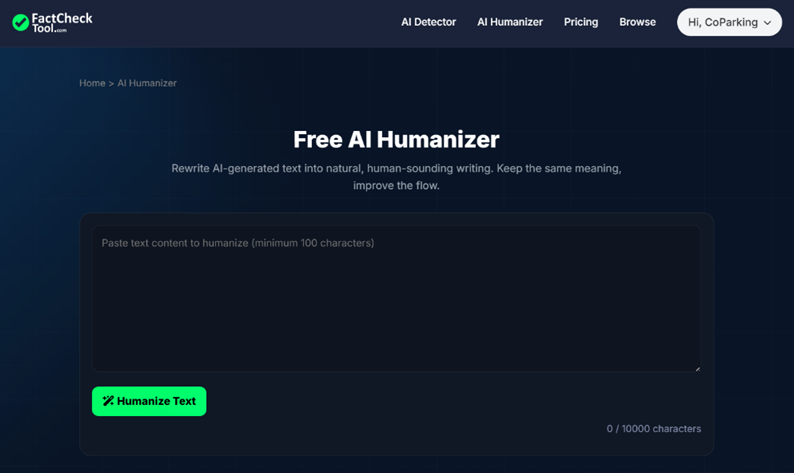
In the age of artificial intelligence, content creation has been revolutionized. ChatGPT, Claude, Gemini, and other AI language models can generate text in seconds—but there's a catch. AI-generated content often sounds robotic, repetitive, and distinctly non-human. This is where AI Humanizer technology becomes essential.
An AI Humanizer is a sophisticated tool that transforms AI-generated text into natural, human-like writing that reads authentically and engages readers effectively. Whether you're a student refining an essay, a content creator scaling production, or a business professional polishing reports, understanding AI humanization is crucial for modern digital communication.
This comprehensive guide explores everything you need to know about AI Humanizers: how they work, why they matter, ethical considerations, best practices, and how they integrate with fact-checking technology like FactCheckTool.com to ensure both authenticity and accuracy.
Understanding AI Humanizers: What They Are and How They Work
AI Humanizers are advanced natural language processing tools designed to rewrite AI-generated content to sound more natural and human-like. They analyze text for common AI patterns and transform them into authentic, engaging writing.
The Core Problem: AI Writing Patterns
AI language models like ChatGPT, Claude, and Gemini follow recognizable patterns:
- Overly smooth tone: AI tends to produce perfect, flowing sentences that lack the natural variations found in human writing
- Repetitive structures: Similar sentence patterns repeated throughout the text
- Generic vocabulary: Predictable word choices and transitions
- Consistent tone: Lack of emotional variation that characterizes human expression
- Formal verbosity: AI often over-explains simple concepts
- Absence of personal voice: Missing the unique writing fingerprint of individual authors
How AI Humanizers Transform Text
Sophisticated AI Humanizers employ multiple transformation techniques:
- Sentence Structure Variation: Breaking up predictable patterns by varying sentence length, complexity, and construction
- Vocabulary Diversification: Replacing generic terms with more specific, contextual alternatives
- Tone Modulation: Adding emotional nuance and personal voice to flat AI text
- Natural Imperfections: Introducing the minor irregularities that characterize authentic human writing
- Context-Aware Rewriting: Understanding subject matter to make appropriate stylistic choices
- Flow Enhancement: Improving transitions and coherence while maintaining conversational rhythm
Why AI Humanization Matters in 2026
The need for AI humanization has exploded as AI detection technology becomes more sophisticated and widespread.
🎓 Academic Integrity
Educational institutions worldwide have implemented AI detection systems. Students must ensure their AI-assisted work maintains academic integrity while following institutional guidelines.
💼 Professional Credibility
In business environments, AI-flagged content can damage professional reputation. Reports, proposals, and communications need to convey authenticity and authority.
📈 Content Marketing & SEO
Search engines increasingly prioritize human-quality content. AI-generated articles that sound robotic face ranking penalties and reduced engagement.
👥 Reader Engagement
Content exists to connect with human readers. Text that sounds artificial creates distance and reduces trust. Humanized content builds authentic connections.
The Complete AI Humanization Process: Step-by-Step
Step 1: Generate Your Initial Content
Start with AI tools like ChatGPT, Claude, or Gemini to create your base content. Focus on getting the core information and structure right without worrying about the writing style.
Step 2: Identify AI Patterns
Review the text for typical AI characteristics:
- Count how many sentences start the same way
- Look for repetitive transitions ("Moreover," "Furthermore," "Additionally")
- Identify overly formal or verbose passages
- Note where the tone feels flat or generic
Step 3: Apply Humanization
Use an AI Humanizer tool to transform the text. Quality humanizers offer multiple options:
- Tone Selection: Standard, Academic, Professional, Creative, SEO/Blog
- Rewrite Depth: Minimal, Moderate, Maximum transformation
- Output Length: Concise, Standard, Expanded versions
Step 4: Review and Refine
Even the best AI Humanizers require human oversight:
- Verify factual accuracy hasn't been compromised
- Ensure the humanized text maintains your intended meaning
- Check that tone and voice align with your brand or style
- Make final adjustments to perfect the content
Step 5: Fact-Check Critical Content
This is where FactCheckTool.com integration becomes crucial. Before publishing:
- Use FactCheckTool to verify factual claims
- Check source citations for accuracy
- Validate statistics and data points
- Ensure context hasn't been lost in transformation
Bypassing AI Detectors: Technical Considerations
How AI Detectors Work
Popular AI detection tools analyze text for:
- Perplexity: How predictable the text is (low perplexity suggests AI)
- Burstiness: Variation in sentence length and complexity (AI tends toward uniformity)
- Semantic patterns: Recognizable AI phrasing and structure
- Statistical markers: Mathematical signatures of AI generation
Common AI Detectors
| Detector | Primary Use | Key Features |
|---|---|---|
| GPTZero | Education | Perplexity and burstiness analysis |
| Turnitin | Academic | Leading plagiarism and AI detector |
| Originality.AI | Content Marketing | Comprehensive detection with high accuracy |
| Copyleaks | Multilingual | Global content detection |
| Content at Scale | Marketing | Marketing-focused AI detector |
| Winston AI | Business/Academic | Enterprise-grade detection |
| ZeroGPT | Free Tool | Basic free detection capabilities |
Ethical Considerations: The Responsible Use of AI Humanizers
⚖️ Academic Guidelines
Before using AI Humanizers in academic contexts:
- Check Institution Policies: Many schools have specific rules about AI use in assignments
- Cite AI Assistance: Transparency about AI tools used in your work
- Use for Appropriate Purposes: Brainstorming, drafting, and editing versus wholesale content generation
- Maintain Original Thinking: Ensure your ideas and understanding drive the content
- Follow Honor Codes: Respect academic integrity standards
💼 Professional Ethics
In business and professional settings:
- Accuracy First: Never humanize content without verifying factual correctness
- Transparency When Required: Disclose AI use when requested by clients or regulations
- Quality Control: Human review remains essential for critical communications
- Brand Consistency: Ensure humanized content aligns with organizational voice and values
📝 Content Creation Standards
For publishers, bloggers, and content marketers:
- Fact-Check Everything: Use tools like FactCheckTool to verify claims before publishing
- Add Genuine Value: Don't just repackage AI content—add original insights and expertise
- Reader-First Approach: Prioritize reader value over search engine manipulation
- Attribution: Cite sources for statistics, quotes, and specialized information
- Originality: Use AI as a tool, not a replacement for creative thinking
Who Benefits from AI Humanizer Technology?
🎓 Students & Academic Researchers
Use Cases: Refining AI-assisted essay drafts, improving research paper clarity, translating complex ideas into accessible language
Benefits: Pass AI detection while maintaining academic integrity, improve writing quality, save time on revision, learn better writing techniques
✍️ Content Creators & Bloggers
Use Cases: Scaling content production, creating engaging blog posts, developing social media content, repurposing content across platforms
Benefits: Produce 10x more content efficiently, maintain consistent brand voice at scale, improve SEO, reduce editing time
💼 Business Professionals
Use Cases: Polishing reports and proposals, crafting professional emails, creating presentations, developing marketing materials
Benefits: Ensure professional credibility, save time on business writing, maintain consistency, pass AI detection in client-facing materials
📊 Marketing & SEO Specialists
Use Cases: Creating authentic marketing copy, developing SEO-optimized content, writing product descriptions, crafting email campaigns
Benefits: Improve search rankings, increase engagement metrics, scale content marketing, maintain brand authenticity
🌍 Non-Native English Speakers
Use Cases: Refining AI-translated content, improving business communications, creating academic writing, developing professional profiles
Benefits: Overcome language barriers, create native-quality English content, build confidence in communications, compete globally
Practical Examples: AI Humanization in Action
Example 1: Academic Essay
Original AI Text:
"Climate change represents a significant challenge for contemporary society. The scientific consensus indicates that anthropogenic factors are the primary drivers of global temperature increases. Moreover, the impacts are multifaceted and affect various ecosystems."
Humanized Version:
"Climate change isn't just an environmental issue—it's one of the defining challenges of our time. Scientists overwhelmingly agree that human activities are driving global warming, and the consequences ripple through every ecosystem on the planet."
Example 2: Business Email
Original AI Text:
"I am writing to inform you that we have completed the analysis of the quarterly reports. The findings indicate several areas requiring attention. Furthermore, we have identified opportunities for optimization."
Humanized Version:
"I wanted to share the results of our quarterly report analysis. We've found a few areas that need your attention, along with some great opportunities to optimize our processes."
Example 3: Blog Post Opening
Original AI Text:
"Social media marketing has become an essential component of modern business strategy. Organizations must adapt to changing consumer behaviors and preferences. This article will explore effective social media tactics."
Humanized Version:
"If you're not using social media for your business in 2026, you're missing out on one of the most powerful marketing tools available. Consumer behavior has shifted dramatically, and smart companies are adapting fast. Let's dive into the tactics that actually work."
FactCheckTool Integration: The Complete Content Workflow
Combining AI Humanizer technology with FactCheckTool.com creates a powerful content production system:
The Integrated Approach
- Phase 1 - Creation: Use ChatGPT, Claude, or Gemini to generate initial content
- Phase 2 - Humanization: Apply AI Humanizer to transform robotic text into natural writing
- Phase 3 - Verification: Submit content to FactCheckTool.com for credibility analysis
- Phase 4 - Refinement: Correct any flagged inaccuracies and strengthen weak claims
- Phase 5 - Publication: Publish content that is authentic, accurate, and engaging
Why This Matters
AI can hallucinate facts. Humanizers can inadvertently alter meaning. The combination of humanization and fact-checking ensures:
- Authenticity: Text sounds genuinely human
- Accuracy: All facts are verified and cited
- Authority: Content builds trust with readers
- Accountability: Transparent sourcing and attribution
Best Practices for AI Text Humanization
Before Humanization
- Start with quality AI prompts—better input produces better output
- Structure content logically before humanization
- Include all essential facts, data, and sources in the original draft
- Note your intentions for different sections
During Humanization
- Choose appropriate tone for your content purpose and audience
- Adjust rewrite depth based on detection bypass needs
- Generate multiple versions and compare outputs
- Review and humanize section by section for better control
After Humanization
- Read aloud—the best test for natural writing
- Verify accuracy hasn't been compromised
- Check coherence and logical flow
- Add personal touches and unique perspectives
- Run fact-checks using FactCheckTool.com before publishing
The Future of AI Humanization Technology
AI Humanizer technology continues to evolve rapidly with emerging trends including:
- Advanced Personalization: Tools that learn individual writing styles and replicate them
- Real-Time Humanization: Live transformation as you type in AI chat interfaces
- Multi-Modal Humanization: Extending beyond text to video scripts and audio content
- Industry-Specific Models: Specialized humanizers for medical, legal, technical fields
- Integrated Workflows: Seamless combination of AI generation, humanization, and fact-checking
Conclusion: The Balanced Approach to AI Content
AI Humanizer technology represents a crucial bridge between the efficiency of AI-generated content and the authenticity readers demand. When used ethically and responsibly, humanizers enable content creators to scale production without sacrificing quality or credibility.
The Key is Balance:
- Use AI for: Efficiency, idea generation, initial drafting, structure, and research synthesis
- Use Humanizers for: Natural flow, authentic voice, engagement, and detection bypass
- Use Fact-Checking for: Accuracy, credibility, source verification, and trust-building
- Use Humans for: Strategy, creativity, judgment, context, and final quality control
Whether you're a student working on an essay, a marketer scaling content production, or a professional polishing business communications, understanding and properly using AI Humanizer technology is essential for success in the AI-powered digital landscape.
The future belongs to creators who can harness AI's power while maintaining the human touch that makes content truly valuable. Start building that future today.
Get Started with Ethical AI Content Creation
Ready to create content that's both efficient and authentic?
Explore FactCheckTool Try AI Humanizer View PricingReferences
[1] Originality.AI. (2025). AI Humanizer Tool. Retrieved from https://originality.ai/ai-humanizer
[2] Grammarly. (2025). Humanize AI Text: Free AI Humanizer. Retrieved from https://www.grammarly.com/ai-humanizer
[3] QuillBot. (2025). Humanize AI: Free AI Humanizer. Retrieved from https://quillbot.com/ai-humanizer
[4] FactCheckTool.com. (2026). AI Detector & Fact Checker. Retrieved from https://factchecktool.com/en/
